Collaborative checklists and public education brochure respond to Chief Coroner Review recommendations and reinforce shared responsibility for septic safety.
The Ontario Onsite Wastewater Association(OOWA), Concrete Precasters Association of Ontario (CPA), and the Ontario Association of Sewage Industry Services (OASIS), have developed two new septic system safety resources to help strengthen public awareness, clarify industry best practices, and support safer practices across the lifecycle of onsite sewage systems.
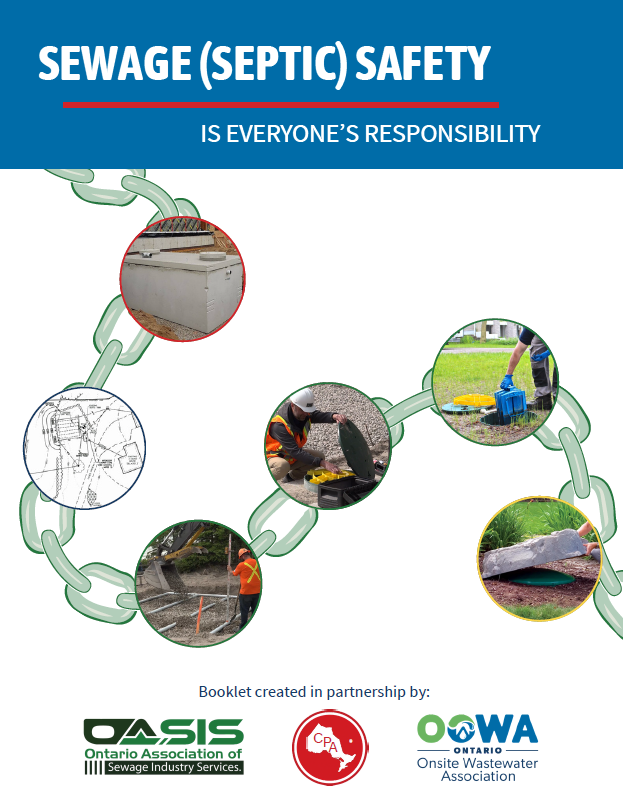
The resources include role-based Sewage (Septic) System Safety Checklists as well as a narrative brochure, Sewage (Septic) System Safety is Everyone’s Responsibility, which explains why septic safety matters and how each person and profession plays a part in preventing avoidable incidents.
The materials were created in response to the June 2025 Chief Coroner Review following the tragic death of a young child in a septic system. The Review recommended that OASIS, OOWA and CPA work together to develop and widely distribute best practice safety expectations for septic tank installation and pumping, including standard inspection checklists, secure closure of access points, secondary safety devices, inspection of lid screws and screw holes, written communication of safety concerns, and reporting of significant concerns to the appropriate authority.
The Review also encouraged a collaborative public awareness campaign and suggested leveraging Septic Awareness Week (September 14-18, 2026) to promote regular safety checks of septic tank access points and secondary safety devices.
Resources Designed for Practical Use
The checklists organize safety responsibilities by role, recognizing that septic system safety depends on decisions and actions taken at every stage: manufacturing, design, installation, inspection, servicing, and ongoing ownership. They highlight practical safety expectations such as secure access openings, properly installed secondary safety devices, safe maintenance access, written communication of deficiencies, and prompt action when lids, fasteners, risers, or safety components are damaged or unsecured.
The companion brochure uses a “safety chain” narrative to explain that septic safety is not the responsibility of one person or profession alone. It emphasizes that when even one link in the chain fails, families, pets, workers, and communities may be placed at risk. The brochure is intended to support broad public understanding and encourage property owners and system users to know where their septic access points are, keep lids and secondary safety devices secured, and to act immediately when hazards are identified.
Stakeholder Notification
Before public release, the Associations shared the completed industry-led materials with relevant stakeholders. Stakeholders were notified that the collaborative resources had been completed and were invited to share them widely.
Stakeholders notified included the Office of the Chief Coroner, Ministry of Education, Ministry of the Environment, Conservation and Parks, Ministry of Municipal Affairs and Housing, the Association of Municipalities of Ontario, and the Rural Ontario Municipal Association.
Summary
Septic safety is a shared responsibility, and these resources reflect the strength of collaboration across Ontario’s onsite wastewater sector.
By working collaboratively, they have developed practical tools that reinforce the importance of secure access points, secondary safety devices, regular inspection, and clear communication when safety concerns are identified. The goal is to help prevent future tragedies by making septic safety expectations easier to understand and easier to act on.
Final materials are expected to be released during Septic Awareness Week from September 14-18, 2026.